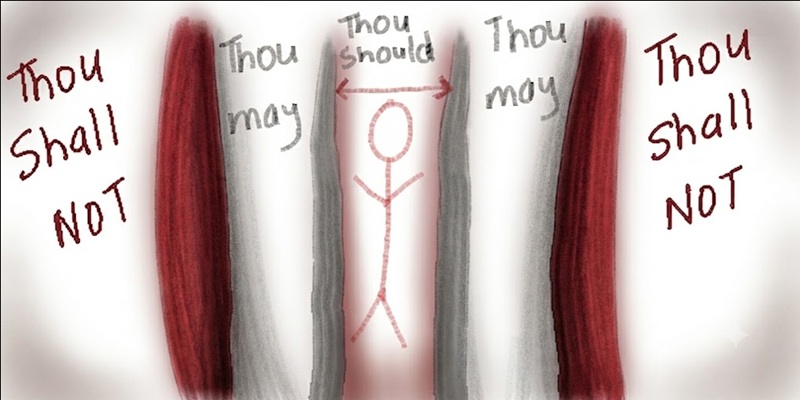
I have to admit, I feel a little crushed by society’s shoulds. And by society I mean all those people around me: people I care for, people I work with, people I plan my weekends with, people I depend on for my income, people I depend on for emotional support. I am sure I am not the only one.
The shoulds of society have always been used as the unspoken constitution governing human action. Romans called it tradition, and they were willing to die and kill for their unspoken shoulds and musts.
But first, What is a ‘Should’, and how is it different from a ‘Must’
I would say a must is something that is enforced with legal lethality. A must is a law encoded into the constitution. A must is something which, if not followed, will necessitate governmental action. A must is something like “you should not harbour a spy.” That is threatened with the highest law of treason; consequences are life imprisonment or even death. A “should” is something like “you should not publicly support the enemy.” “Who is the enemy? What is support?” Well, all that, by its very nature, is purposefully left vague. But you somehow know there will be consequences. The first will be disapproval, and others may follow.
In modern society, as ideas and political ideologies battle it out, Shunting, Shaming and Cancelling are used as the unspoken tools to enforce Shoulds. When culture becomes overburdened with burdensome shoulds, counter-culture gets created. Soon enough, as counter-culture accumulates mass, people and strength, it creates its own unwritten book of shoulds.
The Question is
Are we free, or are we helpless plankton squeezed between the tides of shoulds and should-nots?
My thesis for this essay is that :
To hell with the consequences. If you can survive the consequences, if the consequences are acceptable, you are free. In that sense, you are conceptually free, not necessarily materially.
The first thinker that comes to my mind who wrote about this was Nietzsche.
Nietzsche thought about this and added it to his famous story of “The Three Metamorphoses” in Thus Spoke Zarathustra It’s a story of the transformation of spirit.
- First, It’s a camel laden with a lot of responsibilities, ideas, and things about how things should be.
- Then, it turns into a lion that looks at the dragon of “thou should” and faces it.
- Finally, it turns into a child with forgetfulness to start a new beginning.
THE THREE METAMORPHOSES. You can read about it here - https://www.gutenberg.org/cache/epub/1998/pg1998-images.html
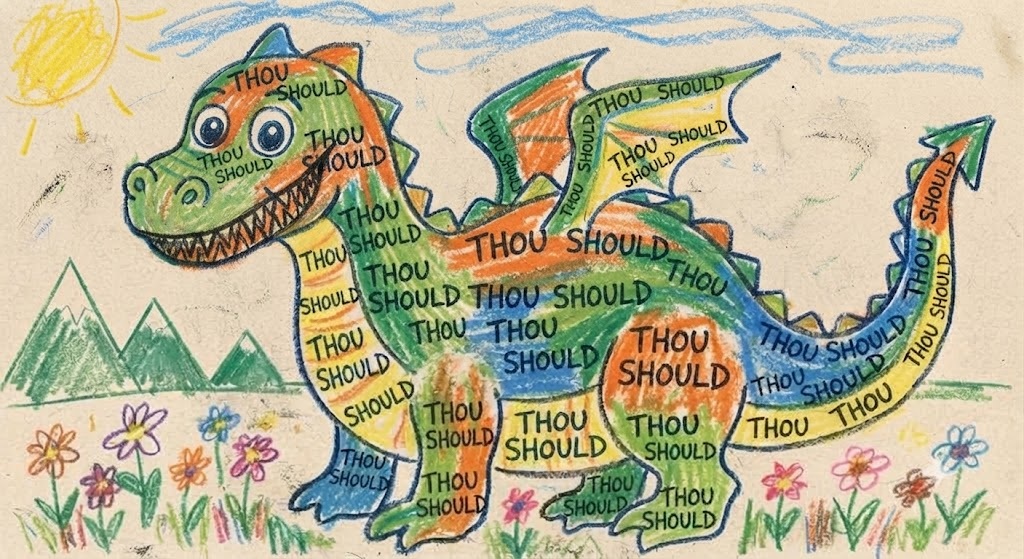
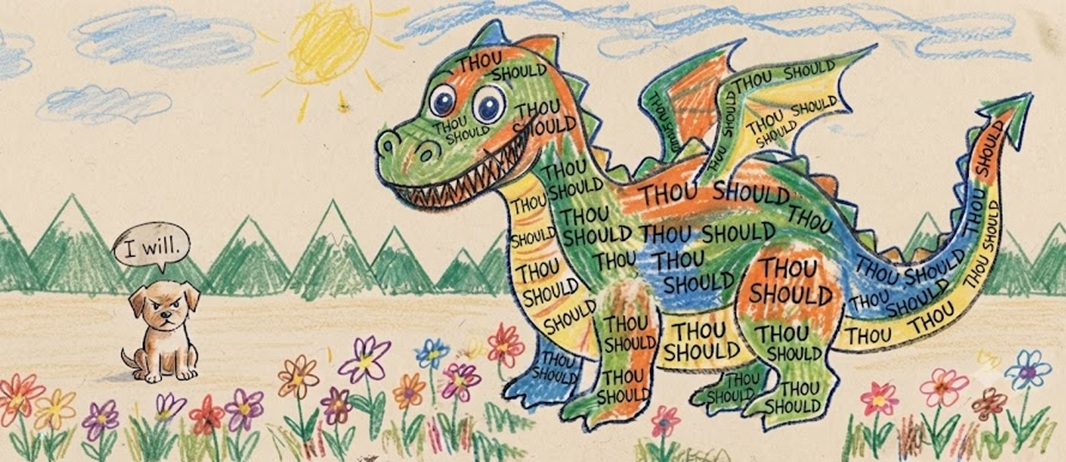
However, most interesting to me is the dragon of “thou shalt,” or rather “thou should.” I see it as a dragon that we must face to stand up in this world. The dragon has teeth. It has fire. It has big claws, and it might use any one of those on us. We do not know. And that is the first problem with this dragon. We do not know what lies on the other side of defying “thou should”
Is it certain death or mild disapproval ? In fact the very game of “thou should” works so well because the consequences are not always written in stone. It is the “fear of the unknown” that ranges from mild disapproval to getting stoned that is used to rein in every little head that dares to stand up straight.
I feel the dragon of “Thou Should” has a menacing face but with a polite expression. It has a condescending smile. It’s on your side, everyone says, including the dragon. “Don’t be afraid of the dragon. Those bad people over there should be afraid of the dragon, but you, you’re on the side of the good, aren’t you?”
It smiles, and you see its gleaming teeth, barely visible but definitely there. People tell you to be free, to live your life, to live openly, to live with courage. And as you stare right at those rows of teeth, a voice in your head whispers, almost afraid that someone else might listen, that someday you might end up between those rows of sharp teeth if you push it too hard. No one knows how hard, but you know there is a line, and that the line is vague, barely visible. Maybe you’re standing on it right now. Look down! Scary, isn’t it ?
The dragon of “thou should” looks on politely, with a wide smile and gleaming teeth.
Rosa Parks

In 1955, a mild-looking lady refused to get off a seat on a bus in Montgomery, Alabama. She was doing it in defiance of an established law called the Jim Crow segregation law. This was not merely a defiance against “shoulds.” This was a defiance against “musts,” a legal imperative. Consequences followed. She was arrested. That arrest led to a movement: the massive civil rights movement of the African American population in the USA. She later said
People always say that I didn’t give up my seat because I was tired, but that isn’t true”… “No, the only tired I was, was tired of giving in.
Today she is sometimes known as the “mother of the civil rights movement”.
Ignaz Semmelweis
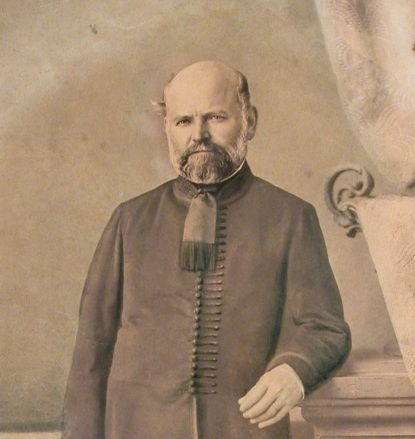
Ignaz Semmelweis was working in the Vienna General Hospital in the 1840s, helping mothers give birth. It was the 1840s, and giving birth then was still a risky, life-threatening process. A lot of new mothers were dying after childbirth. Quite a horrible situation to be in. Each fatality meant an orphaned child for life. Ignaz noticed that a lot of mothers who were examined by students and doctors who had washed their hands with chlorinated lime solution. before examining the patients, had much better rates of survival. It meant another child who got to grow up in the arms of her mother. Every percentage point mattered. He had hit a seminal life saving discovery that required very little extra resoures. It was simple and too good to be true.
All he asked was
Brothers, let’s wash our hands before we touch our patients, shall we?
But the medical community said,
Ummm, No. No, no, no, no, no. That just sounds wrong. Don’t be weird, And stop accusing us of being dirty ?
The doctors of his time did not take it lightly. He was challenging a simple should but one that brushed their ego hard. “Are you saying I’m dirty? Gentlemen don’t carry diseases. What are you hinting at?” It soon turned into graver accusations, almost unspoken accusations. “Are you saying that I killed my patients just because I did not wash my hands? How dare you! ”
His ideas were overall rejected by the medical community. A simple idea but it was rejected. It was not even a “must” but a “should” that he had challenged and it took a heavy toll on his life and his mental health.
He became increasingly frustrated with the medical community. In 1865 he was committed to an asylum and died shortly afterwards at the young age of 47.
According to the Wikipedia article here - https://en.wikipedia.org/wiki/Ignaz_Semmelweis#Breakdown_and_death
Semmelweis surmised what was happening and tried to leave. He was severely beaten by several guards, secured in a straitjacket, and confined to a darkened cell. Apart from the straitjacket, treatments at the mental institution included dousing with cold water and administering castor oil, a laxative. He died after two weeks, on 13 August 1865, aged 47, from a gangrenous wound, due to an infection on his right hand which might have been caused by the struggle. The autopsy gave the cause of death as pyemia (blood poisoning).
Holy F&@K !
I know, right.
Rosa Parks became a legendary figure and lived a relatively peaceful life till the age of 92. Ignaz died at 47 in an asylum, allegedly of blood poisoning.
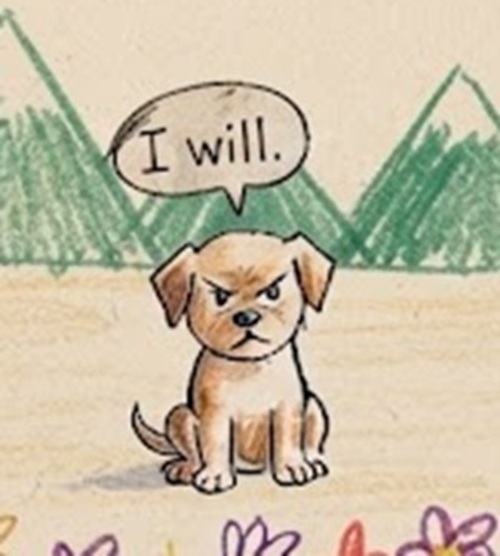
The world is often a hard and unjust place, and while Nietzsche envisioned the spirit as a lion fighting a dragon, truth is, we are more like little puppies against the dragon of Thou-Should. Like this: small, cute, but defiant puppy. ( I love that expression, awww, just look at that face, I want to squeeze it )
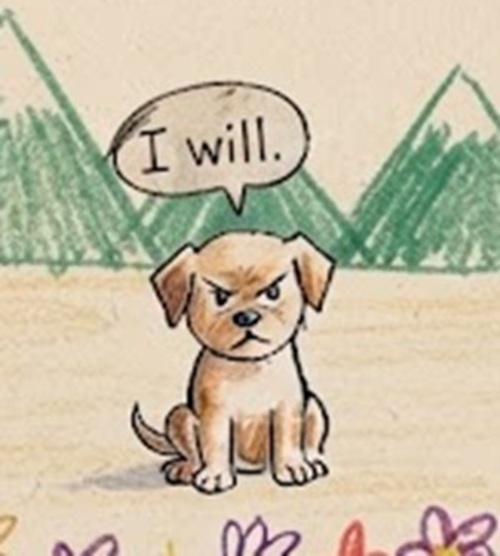
I think it boils down to the art of how many f@$ks to give, as this guy says - https://markmanson.net/not-giving-a-fuck
Consequences are Real
Just like we saw above, consequences are real. The consequences to one’s own mental health, economic health, social standing, approval, and opportunities. Those consequences are very real.
And that is why I like to think of the defiant-will as a puppy, with a defiant expression, ofcourse. You see, a puppy cannot go against a big dragon, straight on. It can face the big beast defiantly, but it cannot fight head-on. It must not. It must be smarter. It must be tactical. It must avoid the sharp teeth and the claws and the fire breath. It must take calculated risks, understand the consequences, and flit around those risks, swiftly. Yes, it might get kicked in the face if it’s not careful. But a puppy can survive a kick, maybe even two, as long as it can avoid the claws, the fire, and the teeth. It will do okay.
Charles Darwin
- July 1837: Darwin began his first private notebook on the “transmutation” of species.
- June 1842 ( 5 years later ): He wrote a private 35-page outline of the theory.
- 24 November 1859 ( 20 years later, yes, 20 ): Darwin published “On the Origin of Species”.
20 damn years !
I know, right.
Today, Charles Darwin is considered a legend. Publicly, he said that he gained a lot of good and necessary evidence in those 20 years, but I am sure, deep down, somewhere, he realised that the little puppy inside him (talking about the theory of evolution here ) would get completely stomped by the dragon of “Thou Shoulds” if he let it out too early and without tact.
Hence, to me it feels like…
The degree of your freedom from ‘thou shoulds’ is proportional to the degree to which you can predict and manage its consequences.
And, in a way, Society does respect the few individuals who are courageous enough to disregard its “thou shoulds”, but it will try to destroy them first. Eat them whole, bones and all. That’s the thorny part.
Consequences can be managed
Charles Darwin managed the consequences and the backlash of his revolutionary idea, carefully and tactfully. So did Timmy when he came out of the closet to his family, and Fatima when she came out of the closet to her family, and Ratna when she told her Parents that she was getting married to a man of a different religion, and Paul when he told his father that he would not become a doctor, but follow his passion as a painter. Finally, there are no shoulds, only consequences.
Living free is not easy, but I heard it’s worth it.
My hope for you is that the fear of consequences doesn’t blind you. That you are able to look the dragon in its face and devise your own ingenious strategy to confront it, declaw it, and protect yourself from its painful and potentially lethal, claw-like consequences. My hope for you is that you have the courage and the calculated risk appetite to bear the little scars that mistakes create, as they eventually will, and that you come out on the other end, free, strong, and crying out defiantly, “I will as I willst”
God Bless!